
A church has been linked to the ancient parish of St Pancras since 314 AD, but the current building dates back to the early nineteenth century. From a design by local architect William Inwood, the foundation stone was laid with much pomp on 1st July 1819 by Frederick, Duke of York and Albany. Three years later, on 7th May 1822, the new church was consecrated for worship by the Bishop of London, William Howley. The total cost was £89,296, making St Pancras the most expensive church to be built in London since the rebuilding of St Paul's Cathedral.
The church is built of brick faced with Portland stone - originally white but, in spite of cleaning, now darkened by years of London pollution. The rich ornamentation is in terracotta. The church's architectural inspiration is the Ionic Temple of the Erectheum on the Acropolis. Its main feature, the caryatid porch, is here used for the two vestries which guard the entrances to the burial vaults.
The caryatid figures, by Rossi, were built up in sections around cast iron columns. The St Pancras figures lack the grace of the originals (one of which is in the British Museum): due to an error they were made too high and had to be truncated at the waist.
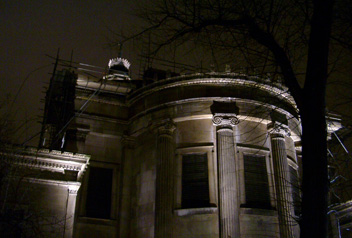
The tower is a copy, much enlarged, of the 'Tower of the Winds', the water clock of Andronicus Cyrrhestes. Originally surmounted by a Corinthian finial carrying the cross, this became dangerous and was replaced with a simpler design in 1953. The tower contains a ring of eight bells hung for chiming.
Text adapted from www.stpancraschurch.org, where you can also find plenty more information about the church.